Sunday, August 26, 2007

Another Bike Ride

After the success of my bike ride / walk Friday morning, I decided to take another bike ride this morning. I wanted to carefully document my ability to walk and balance myself on my feet, since I had some problems yesterday, and it seemed like some of my pills were not working, or certainly not very effectively. I walked around the driveway a bit before the ride, and I was not very good. I was not standing on my own two feet, but found the need to always reach out and grab some support.

I have started doing some tests to determine, to the extent possible, which medicine I take is the "magic pill" -- the one that gives me back my balance temporarily. So last night at 1:50 am, I took a Sinamet, then at 5:20 I took a Mirapex, then at 6:20 I took the rest of the morning pills except the steroid, which I took at 7:30. A little after 7:30 I headed out for the bike ride.

What I found is that the Sinamet seemed to be only slightly effective. By 3 am, I was still careening around, from one support to the next. It didn't get much better if any when I added the Mirapex, and even the other meds had not done much by the tie I left.

So I wasn't expecting much this time. But right on schedule about an hour after the last med (the steroid) was taken at 7:30, I was able to balance standing up and walk with a normal gait. This occurred once I had reached Trader Joe's. As I got off the bike, I could feel that my "balance system" was back in action.

The ride ended up as a very successful one. By the time I got back home I was fully "on," with no balance problems whatsoever. This state has persisted until now, about 2:30 pm, and I hope it lasts much longer.

When I got back home, I set up the video camera on a tripod to get some movies to document how my motor skills are doing. So with no further ado, let me present the film "After the Bike Ride":

Saturday, August 25, 2007

My Theme Song

I liked the message of this song even before this all started, but now it has special meaning for me. I really believe what they say!

Another thing I like: these guys are even older than me! This live version was performed in 1971.


Rare Earth - I Just Want To Celebrate lyrics

I Just Want To Celebrate
By Rare Earth
Note: These lyrics are taken be ear and may not be entirely correct. Any
Corrections would be welcome at jonufroc@indiana.edu
One, two, three, four
I just want to celebrate another day of livin'
I just want to celebrate another day of life
I put my faith in the people
But the people let me down
So I turned the other way
And I carry on, anyhow
That's why I'm telling you
I just want to celebrate, yeah, yeah
Another day of living, yeah
I just want to celebrate another day of life
Had my head on the dollar bill
But the dollar bill flew away
But the sun is shining down on me
And it's here to stay
That's why I'm telling you
I just want to celebrate, yeah, yeah
Another day of living, yeah
I just want to celebrate another day of livin'
I just want to celebrate another day of life
Don't let it all get you down, no, no
Don't let it turn you around and around and around and around and around
Well, I can't be bothered with sorrow
And I can't be bothered with hate, no, no
I'm using up the time but feeling fine, every day
That's why I'm telling you I just want to celebrate
Oh, yeah
I just want to celebrate another day
Oh, I just want to celebrate another day of livin'
I just want to celebrate another day of life
Don't let it all get you down, no, no
Don't let it turn you around and around, etc.
Round, round, round, etc.
Don't go round
I just want to celebrate
Well, I just want to celebrate
Said I just want to celebrate (celebrate)
I just want to celebrate (I want to celebrate)
I just want to celebrate (I got to celebrate)
I just want to celebrate


Song lyrics | Rare Earth lyrics

A Trip to OSH

Later this morning, about 10 am, Tim, Frances, and I went to OSH in South Pasadena. I had taken my morning meds about 7:30, and by 10 I was really doing well. I was balancing just fine, and walking like a normal person (with a funny hat). I walked up and down the aisles without needing any extra support.

I bought lots of new fun "toys": some WD40, paintable calk and a new calk gun, a socket wrench set, a new hammer, a new hat that looks better than my Gilligan hat (Frances' suggestion), some power strips, spools of wiring, new wire cutters, a circuit tester, ... things that provide a middle-aged man hours or days of fun in the workshop!

On the way back home, we stopped by Dave and Angelica Clark's house, so that Tim and I could help them set up their very nice new iMac. I strode right up to their door, and when we went in didn't need to support myself on anything. For the next hour or so, my attention focused on trying to get their iMac communicating on the network, and installing some new software Angelica bought for the girls to use on school projects.

When we were finished and I got up out of the chair, I found that my balance was off again. Angelica drove us home, and by the time we arrived (around noon), I was back to careening around the room. So at 12:30 I took my noon meds, and now I am waiting to see when I recover my balance... hasn't happened yet (1:22 pm), but I'll keep waiting and monitoring.

About Balance

I was thinking the other day that it's odd that so many people with various neurological conditions have problems with simple things like walking, but can still do "complex" things like solving differential equations.

But as I thought about it more, I realized that walking is in many respects harder for the brain than is any intellectual activity, no matter how sophisticated we regard the latter. If my brain has a small time delay in responding to sensory input, it doesn't affect in any significant way purely intellectual tasks. But walking or even standing still requires co-ordinated commands from the brain to the body (especially the feet and legs of course). The timing has to be precise. If you are standing, and start to fall over, your brain doesn't have the luxury of pondering what to do. It has to step into action quickly, before you end up on the floor.

So I conclude balance is actually really hard. The amazing thing is not that I can't do it very well, but that you all can! More on balance in the next post...

First Post-Operative Bike Ride

Yesterday I took my first bike ride since the surgery. Of course I wore a bike helmet, which served the dual role of protecting my head and protecting those I meet along the way from having to view my punk hairstyle underneath... I am happy to report I had no falls whatsoever, so its first role was untested.

Our neighborhood has lots of beautiful street with minimal traffic, just right for bike riding. Despite this, I set as my goal the Starbucks on Fair Oaks Blvd., just north of California Blvd. Maybe this is due to some mental deficit, or maybe I just wanted a good cup of Jo...

Anyway, after practicing getting on and off a bit in our driveway, I set out at about 6 am up our street to California, then right on California to Orange Grove Blvd., where the light was red. I managed to successfully negotiate getting off, walking the bike in the crosswalk, and getting back on on the other side. I rode on the sidewalk, figuring that my extenuating circumstances justified this minor violation of traffic laws.

My next stop was Huntington Hospital. I felt like it has been my "home away from home," so I rode up the main entry road, past the entrance, and then back out to California Blvd. I thought I might see someone I know, but I didn't, so onward to Starbucks...

When I got to Fair Oaks Blvd., I had to get off to cross the road. I walked the bike across Fair Oaks, and then when the light changed, across California. On the sidewalk outside Boston Market, I mounted the bike again, and rode the last few feet to Starbucks, where I dismounted, leaned the bike up against the window of Starbucks near an outdoor table, and went it to join the line of early-morning Starbucks customers.

I do have some distinct balance issues, although I found it quite easy to ride the bike. Much more difficult is walking on my two feet. By using the bike as a big two-wheel "cane," I was able to walk outside pretty well. But inside Starbucks, I didn't have my bike for support, so I leaned on the various tables or displays along the way to the counter. I did get a few strange looks. There were 2 guys dressed in hospital garb that suggested to me that they worked at Huntington in some capacity. I saw them looking at each other as if to say "who let that guy out?"

Anyway, I finally made it up to the counter in my lunging way, and ordered a Grande Coffee and an Apple Fritter. The latter is probably disallowed on an anti-cancer diet, but i figured one couldn't do too much harm, and it sure would taste good. So after I paid, I reversed my path, like a billiard ball bouncing off obstacles, until I made it over the the milk/cream/spoon station, where I added non-fat milk (see? I can be good too!).

Then it was just a few short hops and richochets out the door to the table by my bike. I let myself down into the chair, and enjoyed the coffee and fritter. About 10 minutes later, I was finished, so it was time to hit the road (figuratively). I headed out with my two-wheel Trek 15-speed walking cane. I walked all the way to the Vons parking lot (across the street from Huntington Hospital), where I mounted and did a few laps around the parking lot. Satisfied with my bike riding abilities, I decided to walk home, in order to practice walking.

I find that if I don't think about it, I often put my foot (especially on the left) down incorrectly, making contact at the front first. This is a long-term, Parkinson's-related characteristic, but now post-surgery this tendency is a little bit stronger. Maybe (hopefully) it is only a temporary deficit.

So as I walked my bike back home, I consciously worked on getting my leg out in front, and making contact with the ground with my heel first. Once I got into the rythm, it went fine.

So my "bike ride" ended up mostly as a walk. But it was very valuable for me to see what balance issues I do have, and maybe the practice will begin the process of my brain rewiring some circuits to take over control of balance, to replace ones that were damaged at some point by the tumor. I plan to go out for a ride/walk with my Trek 2-wheel walking cane most days. As they say, practice makes perfect.

Wednesday, August 22, 2007

Another Good Day Today

Today was a good day. There were two major events.

First, at 12:30, we went to the follow-up post-surgery meeting with Dr. Fineman. I like Dr. Fineman very much -- he is an excellent neurosurgeon, and also a real "mensch" (a good, down-to-earth person). Plus he is a regular reader of this blog, which counts for a lot too!

He took the staples out of my incision, and says that in a couple more days I can even wash my hair (such as it is) again. It feels good to be staple-free!

He gave us some prescriptions, mostly continuations of things I am on now (Dilantin, for example), or lower-dose versions of meds I can ramp down, like the steroid.

We also talked about various aspects of the chemo- and radiation therapy, including who is good in the local area and would be covered by my insurance. We agreed the strategy to follow is to pursue the current standard-of-care procedures until they have done everything they possibly can. Then once the limits of conventional current-practice medicine have been reached, begin to think about various experimental approaches being developed at leading research centers in this area. We mentioned we may take a trip up to UCSF to talk to some people there, and he thought that was a fine idea. Also we told him we're going to go out to UCLa next Monday.

Dr. Fineman knows that I am very interested intellectually in some of these advanced methods (most of which use nanotechnology in some way). He thought I should start in now on the big job of reviewing the published literature on concepts for treatment, so that I'll be up to speed when the time comes to pursue getting into some clinical trials, etc. I also am planning to learn as much as I can about relevant work in my colleagues' labs at Caltech. Most of this is very basic science, but I want to know as much as I can about this whole field.

He also asked if I'm getting sleep - I think he was concerned that I'm staying up all night blogging and not resting... but I told him I'm getting 6 to 7 hours of sleep a night, which is my norm, going back to college days. He said that's about how much sleep he gets too, and was satisfied with how much I sleep.

He asked us to come see him again in a month, so we made that appointment with his staff, and said goodbye and came home around 1:40 pm.


Click image to enterThen the other big event was that Emre came over to the house around 2:30, and we had my first post-operative guitar lesson. It went very well, even if we did spend some considerable time simply chatting and catching up. We worked some on the Mazurka Choro (Villa-Lobos), especially the last passage with the triplets, leading to a final sustained A-minor chord.

But mostly it was just great to see him, and to get back to guitar playing. He told me one thing that I am a little worried about -- this Fall, he has to go back to Turkey to take care of his mandatory military service. Apparently, if you are highly educated (he has a Doctorate in Music, and a Master's in Mathematics), and own a business (He and his partners own the Los Angeles Guitar Academy), then the military service requirements are less stringent. But it is still possible he may be gone several months, which means no guitar lessons for me. But much worse, I would worry about him having to go to some very "hot" regions on Turkey's borders with its various middle-eastern neighbors... Hopefully, he will figure out some way to minimize the time he has to spend over there, and away from all his students here in Pasadena, who will miss getting together with him each week to make some beautiful music.

What I look like...

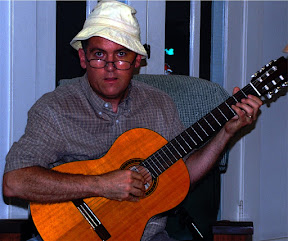
My last photo was not so pretty, so here's a better picture of what I really look like now. The main difference is that this one is taken with my expensive Nikon D40X digital SLR, instead of the tiny camera built into my iMac. But it helps too that I dropped the goofy expression, and picked up a beautiful prop (my guitar).


Some people have told me I look like the guy in the picture below... a certain "Gilligan," who endured a weekly "3-hour cruise" on television for three years in the 60s.
Each week, the weather started turning rough, and the tiny ship was tossed. If not for the courage of the fearless crew, the Minnow would have been lost. The ship set ground on the shore of an uncharted desert isle, with Gilligan, the Skipper too, the Millionaire and his wife, the Movie Star, the Professor and Mary Anne, here on Gilligan's Isle.


I can relate to him, since for me too the weather has had its rough moments lately. I am happy to report, however, that due to the diligent work of the Millionaire and his wife (government agencies such as NIH that fund research on brain cancer treatments, and private foundations that do the same), the Movie Star (those who raise public awareness of this potentially-devastating disease), the Professor (scientists and doctors involved in brain cancer research) and Mary Anne (family, friends, and others who provide the all-important emotional support), the castaways on the uncharted desert isle will be rescued, and returned to their lives before the ill-fated three-hour cruise.

Tuesday, August 21, 2007

Types of Brain Damage

One thing that is always a concern with brain tumors, and with the various forms of treatment, is the possibility of irreversible brain damage.

Physicians speak of the possibility of "mental deficits" due to the tumor invading or impinging on areas of the brain that govern important functions (memory, emotions, speech, vision, etc.) In some cases, there may be temporary deficits after surgery that eventually go away, or there may be permanent ones.

I was very pleased that when I woke up from the surgery I was "still me." I had my mental facilities intact, still remembered everyone, and still thought the same tired old jokes were funny that I did before the surgery.

Before the surgery, I met with a neuro-psychologist, who administered a series of tests to assess my pre-operative mental function. These tests mostly focused on memory. For example, she asked me to name all of the animals I could think of. Of course, having just returned from an African Safari, where I had the seizure that set this whole thing in motion, I tended to come up with African animal names: "Wildebeast, water buffalo, baboon, monkey, vulture, lion, cheetah, hyena, ...". I don't know if I got extra points for "exotic" animals or not.

Then another test went like this: She told me the sad story of Suzie Thomson of South Boston, who was a cook in a school cafeteria, and had 10 hungry children of her own. One day Suzie was out on State Street, and was mugged and robbed of $56. She went to the police station, and the officers were so moved by her story that they took up a collection among themselves to reimburse her for her losses.

The test consisted of her telling me this story, then another unrelated story (which I must admit I don't fully recall, but seemed to involve a young male driver out west in Texas or somewhere, who ran off the road into a ditch, and damaged his car).

She asked me to repeat the driver story, which was easy, since she had just told it to me. But then by surprise she told me to now tell her the Suzie Thomson story. It's hard to get back into a Boston frame of mind after thinking about the wide open highway in Texas!

Anyway, I did pretty well in recalling the details of the Suzie Thomson story, and it seemed that most points were given for recalling details. I remembered her last name because it is the same as that of the famous physicist Lord Thomson, who proposed the "jellium" model of the atom in the early days of atomic theory. And I've been to Boston many times, so I know just where State Street is. (Although the concept of Boston police taking up a collection from their own funds led to some mental dissonance...)

I wonder if the story had been about, say, "Hedda Jmnanovich of Vransk, Poland" if I would have done as well. I've never been to Poland, and can't think of any clever tricks to remember those names... I don't know any streets in any city in Poland.

Anyway, she told me overall I scored above the 99th percentile. As a Caltech academic, this meant a lot to me. At Caltech, we like the 99th percentile. If you are much below than in your high school class, you won't get in as a student. And if you're not at that level as a graduate student, no search committee will recommend you for an Assistant Professor position. So that sounded good to me.

We didn't do a post-operative test, but I don't feel like I'm in any lower percentile now than before.

But it was eye-opening to me to see how they typically measure mental function. It is essentially what we engineers would call "unit operations:" elementary operations, not reducible to simpler steps. For example, they are interested in measuring how fast you can pull words out of memory: "List as many words as you can in 30 seconds starting with the letter S, not including proper nouns". But there was no test concerning pulling the right words out of memory!

For example, an interesting and practical test would be: "Name your wife", or "name your oldest son". If your wife is "Mary" and you say "Sue", I could imagine that this mental deficit might have some very long-lasting and severe consequences. These are the memory tests that matter in the real world! Other practical tests might be "When is your anniversary?", "What is your wife's birthday?". For the record, these are deeply ingrained into my brain, tumor or no tumor.

And then there is the question of mental deficits in reasoning. I was told that the left temporal lobe was responsible for, among other things, integrating individual memories, or sensory input, into more complex ideas. So what really concerned me was that either due to the tumor, or to the surgery to remove it, I might come to find nothing wrong with the following nonsensical statements:
  1. One plus two equals five.

  2. The laws of thermodynamics may be revoked.

  3. A machine that takes in no work and transfers heat from a cold to a hot reservoir with no other effect on the environment is possible to build.

  4. The evidence presented by Colin Powell at the UN before the invasion of Iraq constituted proof that Saddam Hussein had or was building weapons of mass destruction.

  5. There was credible evidence of a link between Saddam Hussein and Al-Queda.

  6. George Bush is a good President.

  7. The profit motive is good for the US education and health care systems.


The mental deficit characterized by belief that the erroneous statements 4 through 7 are true I will call "republicanism", a very widespread affliction of the brain in the areas that govern logic and common sense. This mental disorder only a few years ago afflicted approximately 51% of the American voting public. I am happy to report that today the disorder (especially as measured by question 6) only afflicts about 1/3 of the voting public. It seems that this great success was not due to advances in neuroscience, but to the ability of the brain to identify patent absurdities, and reassess the premises that led to absurd conclusions, such as "Dick Cheney is a smart man who values the opinions of all, and would make a great President."

It is this sort of mental deficit that would really impact my life and career. For example, it would be mildly interesting to ask a question like: "List as many hyperbolic partial differential equations (PDEs) as you can in 30 seconds." But far more relevant would be "list an appropriate set of boundary and initial conditions for a hyperbolic PDE in 2 dimensions; repeat for parabolic and elliptic PDEs." I have to say that if I confused hyperbolic and elliptic PDEs (one of which has wave-like solutions with finite propagation speeds, and the other of which propagates information infinitely fast -- I assume you know which one is which) then I would really be concerned about a mental deficit. Fortunately, the distinctions between hyperbolic, parabolic, and elliptic PDEs is as clear to me today as it was in graduate school, or as it was pre-surgery. I guess we can conclude that the tumor was far from the PDE center in my brain.

Or another thing that would have devastating personal consequences would be if the "thermodynamics" center were affected. For example, if I agreed with any of the following erroneous statements, it would be clear and devastating evidence of a career-ending brain disorder:

  1. It is possible to fully convert heat into work.

  2. Entropy can be destroyed.

  3. Energy can be created.

  4. Global warming is not a problem, no need to change anything about our society to minimize emission of CO2.

  5. Perpetual motion machines are possible, and research into these "novel concepts" deserves DOE funding.


Fortunately, as far as I can tell, my "thermo center" is still functioning well. This means I will be able to keep working on my current research projects, including:

  1. A new collaboration with Sossina Haile in Materials Science, funded by Stanford's Global Climate and Energy Program, to develop high performance solid oxide fuel cell electrodes using recently-developed nanofabrication methods.

  2. The ONR "Research Tools" program, in which we are developing quantitative models and modeling tools for high-temperature solid-state electrochemical systems

  3. Cantera, my object-oriented C++ software package for simulations involving coupled chemistry, electrochemistry, transport processes, surface chemistry, etc.

  4. Our DARPA-funded work on plasmon-enhanced heating via nanoparticles as a tool for deposition of nanostructures, and for pumping, distilling, and concentrating liquid solutions for "lab on a chip" applications.


Also, a mental deficit in the "software center" would be devastating for me professionnally. This could be diagnosed by checking for agreement with any of the following erroneous statements:

  1. If a project presentation has colorful PowerPoint slides, the science must be good.

  2. MS-Windows is just as good an operating system as Mac OS-X.

  3. Fortran 77 is a fine programming language; I don't need to learn any C++.


As far as I can tell, my software center is still intact.

So in summary, it seems the essential parts of my brain for my life and work are still functioning as well as ever (but unfortunately no better than previously... ). So somehow this ~ 1 inch by 1.5 inch tumor was located in some part of my brain that doesn't seem to do much of anything. Perhaps it was located in the "team sports playing" center, or the "civic club joining" center, neither of which seem to work anyway.

Well, that's about all for now -- its nearly my bedtime. I suspect some of you may be thinking about now: "Don't you just hate it when someone thinks surviving brain cancer suddenly makes them qualified to be a stand-up comedian?" I suppose it is possible that I have a deficit in my "tasteful humor" center, or my "knows when to shut up" center. If so, probably years of therapy will be needed...

OK, good night all!
Dave

A new blogger

This is my first ever "blog"...amazing what your kids can teach you. Thanks Dave. I sort of feel like that thing that circulated through our office years ago with a picture of a weird looking guy that said "before I couldn't even spell enjiner, and now I are one".

We, Dave's mom and I, just spent eight days with Dave, Frances, Tim and Erica at their house. We arrived on Sunday August 12th and left the following Sunday. It was the day after my 78th birthday so shortly after we got there Frances and the kids appeared with a birthday cake with candles...not 78, that would have been too much of a fire hazard. I loved it. Thanks Frances and the kids...I'm pretty sure Dave didn't bake it.

We went down to be with them during Dave's surgery. We didn't go there to be with Dave the scientist, or Dave the engineer, or Dave the world traveller, we were there to be with Dave, our son. We knew it meant a lot to him for us to be there during the surgery...we wouldn't have been anywhere else it the world.

I think everyone knows about the surgery from Dave's blog so I won't dwell on that. He's covered that very well. I will say that we are very thankful that things turned out good and the future looks great.

This was kind of like a "mini-vacation" for us. Frances had to work so we spent a lot of time with him and the kids. He isn't allowed to drive so Verma did all the driving in his car. She drove because she is much younger than me...she's only 75. With Dave navigating, and Verma driving, I felt perfectly safe and comfortable in the back seat...why not, I taught both of them how to drive. We ran a lot of errands, made trips to the hospital and medical centers for various tests and ate lunch out a couple of times. This was probably the most time we spent with Dave since he was a kid.

Before and after the surgery we spent a lot of time just being together talking about his sisters and their families, cousins and other relatives, reminiscing about trips in the non-air conditioned station wagon in July, when the kids were little driving across the country to visit my family in Illinois.

I love the things we have in common, only different. Dave is studying classical guitar and doing very well. I love guitars and have owned several. At around 15 I learned to play a few basic chords on the guitar and with a few friends in the "hood" we learned to sing country songs with me playing the chords. Many a summer night we sat on the front porch singing songs we learned on the radio. We didn't have TV or electronic games to play.

I have always been a woodworker of sorts and I was very happy to find Dave had found this interest also within the last few years.

And there's engineering where we are miles apart with his scientific research and my (long ago) designing plant facilities for an industrial plant for 30 years.

That's about it for my "first" blog. Good luck tomorrow Dave with the doctor.

Dad

http://webs.directcon.net/goodvg/index.html

My New Look

Well, I've changed headgear and am no longer sporting the "pirate" look. Here's what I look like today:


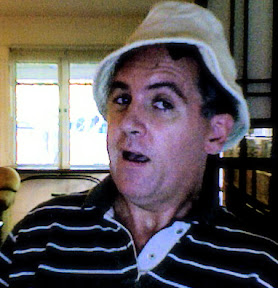
Not so pretty, perhaps, but you have to consider the starting material! I mean, recovering from brain cancer is one thing, but turning me into one of the "beautiful people" we have so many of here in LA is even beyond the ability of my crack medical team... I think of this look as my 40s-noir street-smart look... then again, you may just think of it as my goofy look...

In any case, I'm feeling great! I spent a couple of hours this morning doing some major housecleaning. It felt good to be up and around, making the kids' lives miserable just like nothing was out of the ordinary ("take those shoes up to your room! Is this mess in the kitchen yours?").

The events for today are a visit from Melany Hunt and Tim Colonius, to fill me in on all of the Caltech gossip that I am missing by not going in to the office. Then they will give me a ride to Huntington Hospital for my 11:30 am appointment with Dr. Lam, my radiation oncologist (and head of the radiation oncology department there), to discuss my radiation therapy. Looking forward to getting going on that. It feels great to have the vast majority of the tumor already out, and now the focus is on killing off the microscopic bits that can't be removed surgically, but from which new tumor could grow if left in place. I am very happy to place myself in the able hands of Dr. Lam and his staff to manage this portion of my treatment!

Monday, August 20, 2007

50th Birthday Bash

This October 15th, I will turn 50 years old. [As I told Erica, that means my life is 1/4 over... :) ] To celebrate, we are planning a party the likes of which have not been seen around here in a long time! All of my family, friends, and colleagues are invited, including those of you in Sacramento, Illinois, or wherever else you may be, in addition to the local Pasadena crowd!

We'll probably have a catered party here at the house on Sunday afternoon, Oct. 14. Those of you coming from out of town should plan on coming in Friday and spending a long weekend here. We'll arrange for a block of rooms at some nearby Pasadena hotel. Or those of you with kids might want to combine this with a trip to Disneyland, or Knotts Berry Farm, or somewhere else of your own choosing. And for those coming without kids: perhaps a trip to Tijuana, Vegas, or elsewhere...

This year's birthday is of course special for reasons beyond simply marking the half-century mark. It will celebrate my personal victory over this terrible disease (achieved only with the help of all of you), and the initiation of a new research program at Caltech to explore using nanoparticle-based thermal methods to attack and destroy glioblastomas. For me, it's no longer just about my personal recovery (although that is a prerequisite!): it is about using my experience, and my talents (such as they are), in collaboration with experts in this area, to once and for all DEFEAT this disease, and make total recovery the norm for everyone, not the exception, as it is now with conventional therapies. This GBM disease doesn't know what it's up against! With a crack team of first-rate clinical and research MDs, with a few science/engineering PhDs (like myself) sprinkled in for good measure, the disease doesn't have a chance! We're going to win this by a TKO!

I hope to see all of you in October! You'lll have the opportunity to meet the scientists and doctors from Caltech, Huntington Hospital, and/or other major research centers who are going to make this happen! Don't pass up this once-in-a-lifetime event!

And don't worry about whether you are invited. Everyone who cares enough to be a regular reader of this blog is by definition invited!

Sunday, August 19, 2007

The Way Forward

I have been doing alot of thinking about how to insure I beat this thing. Here's what I think now.

First of all, I will of course first do the prudent things recommended by my physicians to get through the initial period -- conventional radiation and chemotherapy, to fight regrowth of the tumor from those parts that could not be surgically resected. This will buy some time to pursue more innovative and promising approaches.

But then I plan to drop my role as "patient," and take up the role of "scientist/engineer." I intend not only to personally survive this cancer, but I want my case to mark the dawn of a new era in treatment of glioblastomas, in which treatment is curative, not merely palliative. I plan to devote myself and my laboratory at Caltech to achieving this goal, working in close collaboration with my medical team, especially Dr. Igor Fineman, my fantastic neurosurgeon, and a top-notch research scientist himself.

So what is required to achieve this ambitious goal? Fundamentally, it is necessary to be able to selectively destroy tumor tissue, without attacking healthy brain tissue. For GBMs, this is hard, because they are formed from diverse tissue types, and physically intertwine with healthy tissue.

A very promising approach is to use heat to destroy the tumor, if heating agents can be selectively bound to the tumor. One way to do this is to use the body's own immune system, using T-cells that bind to the tumor, and that are also attached to small metal nanoparticles. The net effect is that the tumor can be selectively coated with nanoparticles. These nanoparticles can be heated with an external AC magnetic field, or by laser irradiation at their plasmon frequency (for gold, this is near 600 nm - red light).

In my group at Caltech, we have done quite a bit of work with gold nanoparticles as heaters for other applications (micro/nanostructure formation, fluid pumping in microchannels). But other groups are already using nanoparticles to heat and destroy malignant tumors. I would be very excited to shift our focus to using gold nanoparticles to selectively heat and destroy glioblastomas. I really think this approach may offer the first possibility of curative therapy -- that is, therapy that really gets all of the residual tumor, leaving nothing for further growth!

For this reason, I not only expect to eventually be cured of this GBM, but I expect this will increasingly be the norm! We will go from the present situation, in which survival is measured in months, to one in which patients live many years, and ultimately die of something else. I see no reason to think this cannot happen - it can, should, and (given enough resources and smart people) will happen!

Back in Shingle Springs

We're back home after spending a week with Dave, Frances, Tim and Erica. We didn't get what we had so fervently hoped for, a benign tumor, but we are thankful Dave came through the surgery so well. He amazed us with how rapidly he was back to being himself and was even released from the hospital a day early! I think one of our main task now may be to keep him from doing too much too soon. He is gung-ho to defeat this thing.

Frances has been working in every way to get things done quickly for Dave and by the best people. They will both be doing research and seeking out available treatments and programs. They are a good team with their different scientific backgrounds. We are so grateful Dave has Frances by his side.

Even though there was some sadness in this trip, we enjoyed long talks with Dave about the past, present and future. In addition to some tears, we had many laughs. Of course, we have a long history together so we never lack for something to talk or joke about. We loved being with Dave and his family and look forward with confidence.

Saturday, August 18, 2007

A Walk to the Arroyo

Since I am feeling good today, I decided to take a short walk down to the Arroyo and take a few pictures. I took some shots from the La Loma Bridge, then I went down into the Arroyo and took a picture of the La Loma Bridge.

Then I walked back home by coming up Bradford. It felt very good to get outside in the fresh air, and to get even a little bit of exercise!

Doing well

Things still seem to be going very well, all things considered. Mom and I took a walk around the block this morning, and it felt good to get out in the fresh air. Today is just a day for relaxing -- some blog writing, a bit of napping, some TV watching... We've got a bit of a break until the next "event", which will be the meeting with Dr. Fineman on Wednesday. I am really curious to see how the pathology report comes out. The nature of the tumor cells as shown in the microscope images will go a long way to determine whether this tumor is really a GBM, or might be a lower-grade tumor... Whatever the identity, I am prepared to fight its recurrence with all my energy and all the technology we can muster. I'm starting to learn more about the various chemotherapy and radiation options, including research trials. I will of course follow the guidance of my "crack" medical team, but I plan to play an active role too. And as a Caltech scientist/engineer, I think I can understand some of the science underlying treatment decisions. I plan to learn what I need to know of the science to converse intelligently with my doctors.

And of course I need to get back to my own science (fuel cells, CVD, Cantera, ...) real soon! The Global Climate and Energy project is going to be fascinating, and also I need to write up my section of our paper on our on-chip technique to carry out distillation and concentration (for example, of DNA).

And then I've got to start thinking about ME 122 ("Sustainable Energy Engineering") in January... All of this is very welcome. I am looking forward very much to teaching this class, and think that the preparation for it in the next few months will itself be therapeutic, by giving me something significant and interesting to do that is not about me in a "patient" role.

And then of course there is classical guitar playing... I am really looking forward to improving my technique. Emre has very generously agreed to give me lessons at home, while I can't drive. I am very much looking forward to mastering the Villa-Lobos pieces that I am working on, learning more of the Cardoso pieces, and adding a few more new pieces... This is what I call really fulfilling and fun!

I also want everyone to know I appreciate so much the concern, love, thoughts, and prayers that so many of you have offered! I truly think it makes a real difference! I know without question that I am blessed!

Friday, August 17, 2007

My new "pirate" look


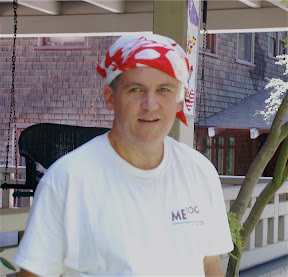
I'm doing amazingly well, considering what I've been through in the last couple of days. I'm sporting a new "Pirates of the Carribean" look. I feel very good - I am up and about, have lots of energy, and am very happy to be home. I feel basically normal: no pain, no weakness, no sign of mental deficits. (On the other hand, I don't seem to have improved mentally either...)

Basically, I am my normal self. I don't feel like an invalid, or a "patient," and I am looking forward to diving back into teaching and research.

Since the tumor is largely gone now (thank you, Dr. Fineman!), and the radiation and chemo will clean up the residual, I don't see any reason to think this thing is going to stop me. The t-shirt I am wearing is from our Mechanical Engineering Centennial Celebration, but now I have a new interpretation for the logo on the front ("ME 100"). I am interpreting it as my life expectancy...

I am very, very grateful to my loving family, caring friends and colleagues, and my "crack" medical team! You are all fantastic!

Some Photos

What I looked like very recently:


Last pre-operative photo, with short haircut:


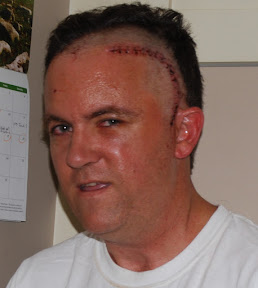
What I look like Friday morning, nearly 3 day post op:


This is my "Frankenstein's Monster" look. Don't worry, though - -the next time you see me in person I'll look much more civilized. Frances is out at this minute getting me some sort of new bandage or floppy hat, so that I won't unduly alarm small children or animals.

Thursday, August 16, 2007

Next steps

The immediate task is to recover from the surgery. Then on Wednesday, I'll have an appointment with Dr. Fineman, and on Thursday one with Dr. Girard. At these meetings, we'll presumably discuss the long-term treatment options, which will require getting a neuro-oncologist involved too, to manage the long-term radiation and chemotherapy program. At this point, I am willing to do whatever it takes to maximize my odds of long-term survival - radiation, chemo: bring it on. I've got far too much to live for to cut life short for any reason.

Discharged

This afternoon I was discharged from the hospital and am now at home. Even though the Huntington staff were all great, there is no place like home. And it is great to see Tim and Erica again.

What I have

When Dr Fineman finally got my head opened up and could see the tumor, he found that it was not a slow-growing, benign tumor, but instead just the opposite: a glioblastoma multiforme or GBM,the most aggressive form of the primary brain tumors known collectively as gliomas. He broke the news to Frances and me today at our initial post-operative meeting with him. These results are still preliminary, however, since the pathology report is not finished. We will have a second post-operative meeting with him next Wednesday, hopefully with the final pathology report.

But from my perspective, there is NO REASON to despair. Although the "average" patient with a GBM may not do particularly well, I have never been "average" in anything I've done, and I sure don't plan to start now. There are patients who beat this, and I plan to be one of them. I have a crack medical team, a wonderful wife and family, and great friends and colleagues world-wide. I am involved in scientific work (energy research, specificallly fuel cells) that I find very stimulating, and that I believe is important, not only for my personal survival, but for our survival as a civilization into he next decades and centuries. That must count for something!

I am not one to rely on "God" stepping in to fix things - I tend to trust in science and technology. (Nevertheless, prayers to the God of your choice [Christian, Jewish, Buddhist, ...] will be gratefully accepted!) GBMs do respond to radiation and chemotherapy, and so there are things one can do to fight the residual tumor that couldn't be surgically resected. I am more than happy to do radiation, chemo, or whatever it takes to beat this thing! I feel we're only beginning to fight!