This morning (Sunday) I woke up very early, as I described in my last post. I got up, got dressed, and logged onto the laptop to do some e-mail, blog posting, etc. But about 4:45, I decided to go out for a walk to get some exercise. Of course, it was still quite dark, but I jogged/walked from our motel near the pier, up Ocean Avenue to 6th street, over to the public beach access stairs, down to the beach, then back almost to the pier, but I stopped when I got to our motel.
I finished up just before 6 am, and was interested in getting a coffee and something to eat. I had planned to go to Kelly's Espresso Bar, but when I showed up there a little after 6, they were still closed. As I was walking away from Kelly's, I noticed a man leaning out of a second-story window across the street, talking to a woman in a truck down on the street. So I yelled up to him: "Excuse me sir, do you know when Kelly's opens?" He said they may not open at all today (!!). But then he told me that "O'Neil's" coffee shop was just about 3 blocks down the road, and he knew for sure that it was already open. So I set off for O'Neil's.
As it turned out, it was less than a block from our motel, so it was actually very convenient. I went in, and there were just a few customers at this early hour,
and a woman working behind the counter. I ordered a coffee and a muffin, and sat down at an empty table to look through some of the local newspapers.
But then I noticed a man talking to the person working behind the counter. (They seemed to be old friends, as did most of the people in O'Neil's; maybe there is a confederacy of "6 am coffee drinkers.") I overheard him mention that he had had some health problems, and that they caused him some problems with movement.
That sounded pretty familiar to me, and I wanted to know what the nature of his health problem was, and whether it was anything like mine. So I did something pretty out of character for me: I said to him "Excuse me, sir, but I couldn't help overhearing your conversation about some health problems you have; personally, I have Parkinson's Disease (diagnosed in 1998) and Brain Cancer. Would you mind telling me what your condition(s) are?" I've found that "Brain Cancer" seems to get people's attention, and among others with health issues confers a certain respect or credibility -- this is not the flu we're talking about here!
Without a moment's hesitation, he told me that he had had a couple of strokes, and has continuing movement-related issues as long-term side effects of the strokes. Very soon another customer, who was sitting nearby at another table and seemed to know the first guy very well, told me that he has severe back pain, and is getting Workman's Comp, but has a lot of problems with the "bureaucracy" and rules of the California Workman's Compensation program. For example, he is learning guitar (blues, rock, ...) and is willing to play through considerable pain in order to keep up with his lessons. (I can relate to that...) The problem is "guitar playing" is something that people in his condition aren't supposed to be able to do, according to the Workman's Comp guidelines. So the conclusion is that if he can do this, he must be cheating, and can be kicked out of the program. What the guidelines don't take into account is that he absolutely loves making music, and is willing to put up with considerable pain to do what he loves.
A woman who seemed to be a good friend of his and was sitting at a nearby table told me how happy she was to meet me, and she thought I had a very good, positive attitude about the Brain Cancer. The three of them were all permanent Cayucos residents; I told them that I was not a local, and was only here for 3 days, although we have been to Cayucos every summer for several years. Then she happened to mention that she was originally from Carmichael! Of course, I immediately told her I grew up in Rancho Cordova, and went to Cordova High. (Carmichael and Rancho Cordova are both Sacramento suburbs, not far from one another at all. We often played the teams from Carmichael in high-school football and other sports.) So then we talked a bit about high schools, etc. She graduated in 1969, I graduated from Cordova in 1975, and the other guy graduated from somewhere else not in Sacramento (near Cayucos, I think) in 1977.
All three of the people I talked to had faced health issues themselves, or had had friends with serious health problems. But they all had put aside feelings of depression, or anger, or other negative feelings, and were trying to focus on the positive.
When I had to leave, they gave me a sticker that said "Live in Peace," and had a peace symbol on it. Apparently it had something to do with the 40th commemoration of the "Summer of Love" in San Francisco in 1967 - of course, none of us were old enough to have actually participated in the Summer of Love. (I was 10).
I promptly went back to our motel room, and applied the sticker to my Mac PowerBook.
The people I talked to at O'Neils were very, very nice, and the thing that struck me is that they had all faced significant health-related adversity, but had come through it with a positive, peaceful attitude. It was a real pleasure to meet and talk with them, and they said that they enjoyed meeting me too.
A great way to start the day!
Note: although all 3 introduced themselves to me, I am not using their names because I didn't mention the blog to them (I forgot!), and so don't have their permission to appear in the blog.
Sunday, September 2, 2007


A Good Place to Be
Ah--- Cayucos, that's the place to be. It is supposed to be 102 degrees here today. We just returned from having lunch at the Apple Cafe. That is up past Placerville just before you get to Apple Hill. Now we will stay in the house with the air conditioning for the rest of the afternoon.
Cayucos is a good place for a vacation, whether it be short or long. I know we have enjoyed all the times we have been there. It is great that you gave Beachfront Rentals credit for refunding the money you paid for the rental of the house there that you had to cancel. Not every company would have. They deserve a gold star.
I am going to post a couple of pictures of our stay in Cayucos last year just to see if I am smart enough to figure out how to do it.


To Sleep - Perchance to Dream?
Saturday night I got to bed just after 9 pm, which meant, as usual for me, that I would be ready to get up and start the day 6 hours later: about 3 am. Sure enough, just about 3 am, I woke up, got out of bed, and got dressed. I was not in the least sleepy, had no desire to sleep any longer, and wanted to see what was new outside or on the internet. To most of you, this must seem very odd, but that's just how sleep is for me. When my head hits the pillow, I am usually out very quickly. I hardly ever have any memory of lying in bed trying to get to sleep. It feels to me as if I almost immediately go into a dream, and when I wake it often seems to be directly from a dream. Most people have 4 stages of sleep, and dream only in stage 4. But I seem to either skip right to stage 4, or else dream in all stages. This has one annoying side-effect: sometimes I have a hard time telling dreams from reality. I've even asked others how they know what's a dream and what's real. Is the dream in black and white? Or is there a flashing subtitle saying "Not Real! Don't Try This at Home!" How do you do it?
I think for most people, their dreams are so wacky that afterwards it is very clear that it was a dream, not reality. But lately I've been having dreams that are very similar to real life. For example: many old friends have called me once they heard about my health issues. Then I have had dreams in which other old friends called, or in some cases came by the house. So afterward as I think back on these visits or phone calls, it is really not so easy to figure out who really called and who didn't...
I've concluded that I need to start collecting tangible evidence of where I have been or who I have talked to. For example, in the next blog post I'll describe a conversation with several people on Sunday morning. I know this conversation really took place, and was not just some dream, because they gave me a sticker that says "Live in Peace" that now graces my Powerbook. If it were a dream, then where did the sticker come from? So I'm going to try to get a business card, or something tangible, each time I meet with someone. This will then serve as proof to me later that the meeting really happened...
Hopefully, all of these problems of distinguishing dream from reality are a temporary side effect of the recovery from the surgery, or the radiation or chemotherapy, and will not be a permanent problem...
Maybe I just need to get out more, so that I have MORE INTERESTING, less-realistic dreams! Unfortunately, not much chance of that for a while...
I think for most people, their dreams are so wacky that afterwards it is very clear that it was a dream, not reality. But lately I've been having dreams that are very similar to real life. For example: many old friends have called me once they heard about my health issues. Then I have had dreams in which other old friends called, or in some cases came by the house. So afterward as I think back on these visits or phone calls, it is really not so easy to figure out who really called and who didn't...
I've concluded that I need to start collecting tangible evidence of where I have been or who I have talked to. For example, in the next blog post I'll describe a conversation with several people on Sunday morning. I know this conversation really took place, and was not just some dream, because they gave me a sticker that says "Live in Peace" that now graces my Powerbook. If it were a dream, then where did the sticker come from? So I'm going to try to get a business card, or something tangible, each time I meet with someone. This will then serve as proof to me later that the meeting really happened...
Hopefully, all of these problems of distinguishing dream from reality are a temporary side effect of the recovery from the surgery, or the radiation or chemotherapy, and will not be a permanent problem...
Maybe I just need to get out more, so that I have MORE INTERESTING, less-realistic dreams! Unfortunately, not much chance of that for a while...
Saturday, September 1, 2007
Saturday in Cayucos...
We had a good time today in Cayucos, and look forward to the next 2 days. We checked in around 2 pm, and didn't do anything structured for the rest of the afternoon. The kids and Frances spent some time down on the beach, while I went on a walk down Ocean Ave. (the main street in town) to get my legs used to moving after a long ride in the car this morning...
Along the way, I stopped in a few of our old haunts: the video arcade and DVD rental store; the small grocery store; and Beachside Rentals, the rental agency that handles the listing for the beach house we rented last summer and were going to rent this summer.
At Beachside Rentals, I spoke to Kathy, who remembered me well when I told her my name. She asked how I was doing, so I told her quite truthfully that I felt great. When I told her the brain tumor that I had referred to in our correspondence regarding our need to cancel the rental turned out to be malignant (i. e. brain cancer), she told me that she knew someone who had brain cancer similar to my case, and who has now been cancer free for 5 years! That's what I want to say 5 years from now too! (OK, let's say in 5 years and a couple months!)
Beachside Rentals gave us a full refund on our 1-week rental fee, even though we had to cancel quite late and had pre-paid in full. They are a great company, have great rental listings, and if you ever want to rent a house on the central coast of California, I recommend them to you most highly!
 . Once I got back to the motel, we got ready to go to dinner. We had a very nice dinner at Cafe Della Via (Caesar Salad, Fettucine Primavera, Iced Tea for me), and then walked back full and contented to the room, and got ready for bed.
Along the way, I stopped in a few of our old haunts: the video arcade and DVD rental store; the small grocery store; and Beachside Rentals, the rental agency that handles the listing for the beach house we rented last summer and were going to rent this summer.
At Beachside Rentals, I spoke to Kathy, who remembered me well when I told her my name. She asked how I was doing, so I told her quite truthfully that I felt great. When I told her the brain tumor that I had referred to in our correspondence regarding our need to cancel the rental turned out to be malignant (i. e. brain cancer), she told me that she knew someone who had brain cancer similar to my case, and who has now been cancer free for 5 years! That's what I want to say 5 years from now too! (OK, let's say in 5 years and a couple months!)
Beachside Rentals gave us a full refund on our 1-week rental fee, even though we had to cancel quite late and had pre-paid in full. They are a great company, have great rental listings, and if you ever want to rent a house on the central coast of California, I recommend them to you most highly!
. Once I got back to the motel, we got ready to go to dinner. We had a very nice dinner at Cafe Della Via (Caesar Salad, Fettucine Primavera, Iced Tea for me), and then walked back full and contented to the room, and got ready for bed.
Cayucos!
I'm writing this post from the little central California beach town of Cayucos. We have come here every summer for the last few years, but thought we would miss it this year. Fortunately, Frances has a 100% functional brain, and had the bright idea that we could drive up to Cayucos for Labor Day Weekend. We left early this morning (Saturday), and, after lunch in Cambria, arrived at our motel about 2 pm.
Unlike all other years when we have come here, I didn't do any driving this time - I was just a passenger! We have a motel right on the beach, and I think these 3 days will be very relaxing. Then we need to be back in Pasadena by 8 am Tuesday morning, since the kids have school (for Erica, it is the first day of school). And for yours truly, I have a radiation therapy session. The radiation is not causing any problems. Each session lasts only 10 or 15 minutes, and all I have to do is lie still - that is one skill that I've perfected over the years. So far at least, I don't have any significant side effects of the radiation. But they told me that the side effects peak a few weeks into it, so... we'll see. But so far so good!
Unlike all other years when we have come here, I didn't do any driving this time - I was just a passenger! We have a motel right on the beach, and I think these 3 days will be very relaxing. Then we need to be back in Pasadena by 8 am Tuesday morning, since the kids have school (for Erica, it is the first day of school). And for yours truly, I have a radiation therapy session. The radiation is not causing any problems. Each session lasts only 10 or 15 minutes, and all I have to do is lie still - that is one skill that I've perfected over the years. So far at least, I don't have any significant side effects of the radiation. But they told me that the side effects peak a few weeks into it, so... we'll see. But so far so good!
Thursday, August 30, 2007
Basketball
My history with the game of basketball goes back to 1965, when my uncle Dick came out from Illinois and spent a couple of weeks at our house in California. I was 8 years old at the time, and Dick was 19. There were several things about him that made him "cool" in my opinion. He listened to rock and roll music, not the country western music that my Dad (and Dick's older brother) favored. And he preferred white bread for sandwiches, not the "healthy" whole-wheat bread that we had always eaten. For the first time ever, we had white bread in the house, and it sure was good!
![]()
While he was visiting, Dick and I often went down the street to our elementary school (Williamson) to practice shooting the basketball. The "courts" were asphalt, and were playground size - certainly not full NBA regulation courts!
I had fun playing basketball with Uncle Dick (well, most of the time), but I'm not sure he did. I had the habit of walking, not jogging or running, to retrieve balls that had bounced out of the court. I figured: "What's the hurry?" Plus I was not in great physical condition, and actually running, in any form, seemed to be a very bad idea to me. Dick often told me I needed to "hustle" more.
After Dick left us to go back home to Illinois, my interest in basketball began to fade.
Looking back on it now, I agree completely with Dick's point of view about "hustling". It really slowed things down if I leisurely ambled to where the ball was. But from the perspective of a lazy 8-year-old, "hustling" took too much energy. Anyway, I still enjoyed Dick's visit very much... it was an introduction to a world that I didn't know existed (white bread, AM top 40 radio, hanging out at th local McDonalds, ...)
Although we didn't know it at the time, Dick's life was to change dramatically in another year or two. He was with a bunch of friends in a car, and they had a serious traffic accident.(I don't know the details, but apparently Dick was a passenger, not the driver.) I think Dick was thrown from the car. He broke his spinal cord near his neck, and wound up in a wheelchair. He is in a wheelchair to this day.
This came as a great shock to him and to his family. I still remember getting the call to tell us what had happened. It was one of the few times I can remember that I couldn't keep from crying.
But a funny thing happened. Over the next few months and then years, Dick began to act like he was a new person, with a new and much better outlook on life. It was if he had a reason to live that he didn't before. He had been a kid without a future - he said he was on the road either to prison or to the graveyard before the accident. But after the accident, he started to grow up quickly. He enrolled in college, and finished four years later with a degree in Sociology, and then even got a Master's Degree.
After he finished with his MS, he got a job with "Impact", an organization that helped people with many different kinds of disabilities to live independently, and eventually became its director. From wild teenager to (a few years later) director of a center for independent living -- that's quite a transformation, and a very inspiring one. I do regard Dick even today as a inspiring example of how adversity, illness, or disability does not have to be the "end" -- in fact, it can be the beginning of a new and very satisfying life. Dick was with Impact for a long time (25 years, I think) and did an enormous amount of good for people with many diverse mental and physical ailments.
OK, now back to basketball...
In recent years (starting about 2002) I became a fan of NBA basketball. This was out of character for me, since I had never been much of a sports fan before. But I found it enjoyable to watch the Sacramento Kings, who had never been good at all, but suddenly were holding their own against teams like the Lakers, the Dallas Mavericks, and the San Antonio Spurs - the "elite" NBA teams. So, since I was born and raised in Sacramento, I enjoyed seeing them come in as the underdog and defeat these powerhouse teams.
When the 2003 season rolled around, I even took the kids a couple of times to Staples Center when the Kings were in town to play the Lakers or the Clippers. We had fun. The kids found the basketball game a bit boring, but the liked the half time show, and especially the various things to eat and drink that were on sale.
Since then, it has been my habit to watch not only the Kings games, but also other teams I came to like - the Clippers, Lakers, San Antonio, Phoenix, Dallas, etc. Even my kids were amazed at the extent of my transformation from total non-sports fan to ardent basketball fan. But it didn't carry over to other sports. I still find baseball boring, and football is OK but I never seem to get around to watching it. Same with soccer. But somehow for me, basketball is much more interesting.
Now just so we are clear, I have to state that my new-found interest in basketball has not yet extended to actually playing the game. I should, of course, for exercise. But I think my skill level is not so high, so I would have to find other players without very high expectations...
In any case, we do have an old basketball hoop mounted on our carport, and I have a fairly new basketball. The kids and I occasionally play around with it, but never play "serious" games. But I have learned to shoot a bit, and I think this is a good way to test and to improve skills involving hand/eye coordination.
So I thought it would be interesting to try to do some free-throw shooting, just to see if I can still do it at all...
The movie below, taken by Tim, tells the story of our "basketball experiment" today.
While he was visiting, Dick and I often went down the street to our elementary school (Williamson) to practice shooting the basketball. The "courts" were asphalt, and were playground size - certainly not full NBA regulation courts!
I had fun playing basketball with Uncle Dick (well, most of the time), but I'm not sure he did. I had the habit of walking, not jogging or running, to retrieve balls that had bounced out of the court. I figured: "What's the hurry?" Plus I was not in great physical condition, and actually running, in any form, seemed to be a very bad idea to me. Dick often told me I needed to "hustle" more.
After Dick left us to go back home to Illinois, my interest in basketball began to fade.
Looking back on it now, I agree completely with Dick's point of view about "hustling". It really slowed things down if I leisurely ambled to where the ball was. But from the perspective of a lazy 8-year-old, "hustling" took too much energy. Anyway, I still enjoyed Dick's visit very much... it was an introduction to a world that I didn't know existed (white bread, AM top 40 radio, hanging out at th local McDonalds, ...)
Although we didn't know it at the time, Dick's life was to change dramatically in another year or two. He was with a bunch of friends in a car, and they had a serious traffic accident.(I don't know the details, but apparently Dick was a passenger, not the driver.) I think Dick was thrown from the car. He broke his spinal cord near his neck, and wound up in a wheelchair. He is in a wheelchair to this day.
This came as a great shock to him and to his family. I still remember getting the call to tell us what had happened. It was one of the few times I can remember that I couldn't keep from crying.
But a funny thing happened. Over the next few months and then years, Dick began to act like he was a new person, with a new and much better outlook on life. It was if he had a reason to live that he didn't before. He had been a kid without a future - he said he was on the road either to prison or to the graveyard before the accident. But after the accident, he started to grow up quickly. He enrolled in college, and finished four years later with a degree in Sociology, and then even got a Master's Degree.
After he finished with his MS, he got a job with "Impact", an organization that helped people with many different kinds of disabilities to live independently, and eventually became its director. From wild teenager to (a few years later) director of a center for independent living -- that's quite a transformation, and a very inspiring one. I do regard Dick even today as a inspiring example of how adversity, illness, or disability does not have to be the "end" -- in fact, it can be the beginning of a new and very satisfying life. Dick was with Impact for a long time (25 years, I think) and did an enormous amount of good for people with many diverse mental and physical ailments.
OK, now back to basketball...
In recent years (starting about 2002) I became a fan of NBA basketball. This was out of character for me, since I had never been much of a sports fan before. But I found it enjoyable to watch the Sacramento Kings, who had never been good at all, but suddenly were holding their own against teams like the Lakers, the Dallas Mavericks, and the San Antonio Spurs - the "elite" NBA teams. So, since I was born and raised in Sacramento, I enjoyed seeing them come in as the underdog and defeat these powerhouse teams.
When the 2003 season rolled around, I even took the kids a couple of times to Staples Center when the Kings were in town to play the Lakers or the Clippers. We had fun. The kids found the basketball game a bit boring, but the liked the half time show, and especially the various things to eat and drink that were on sale.
Since then, it has been my habit to watch not only the Kings games, but also other teams I came to like - the Clippers, Lakers, San Antonio, Phoenix, Dallas, etc. Even my kids were amazed at the extent of my transformation from total non-sports fan to ardent basketball fan. But it didn't carry over to other sports. I still find baseball boring, and football is OK but I never seem to get around to watching it. Same with soccer. But somehow for me, basketball is much more interesting.
Now just so we are clear, I have to state that my new-found interest in basketball has not yet extended to actually playing the game. I should, of course, for exercise. But I think my skill level is not so high, so I would have to find other players without very high expectations...
In any case, we do have an old basketball hoop mounted on our carport, and I have a fairly new basketball. The kids and I occasionally play around with it, but never play "serious" games. But I have learned to shoot a bit, and I think this is a good way to test and to improve skills involving hand/eye coordination.
So I thought it would be interesting to try to do some free-throw shooting, just to see if I can still do it at all...
The movie below, taken by Tim, tells the story of our "basketball experiment" today.
Tuesday, August 28, 2007
Monday, August 27, 2007
Thank You for Your Prayers
Many of you have told me privately that you are keeping me and my family in your prayers. I want to take this opportunity to thank you all. We may or may not share the same beliefs or be of the same faith, but I regard prayer of any type, offered sincerely, as one of the highest forms of love. So again, thank you all.
Caltech is a very international place, and I have friends, colleagues, and relatives who, taken together, cover the bases of the major faiths. In particular, I have relatives who are profoundly spiritual Christians, and we know we are in their prayers. I also have some devout Hindu colleagues here at Caltech, and they are offering prayers to their many Hindu gods. Another friend is Buddhist, and has lit candles for us in a Buddhist temple. Still other friends who are observant Jews have offered prayers for us.
I don't want to get into discussions of which religion is "correct" in this blog -- that could only divide us, when the most important thing is to be united against this disease. So I will not go into my own personal beliefs (or lack thereof) about matters theological in this blog.
The most important thing, from my point of view, is that the prayers are offered in all sincerity. Even if I don't fully understand your faith tradition, your sincerity, concern, and love for us comes through loud and clear. Thank you all.
But now for those of you who do not typically pray, I am not asking you to do anything that does not come naturally for you, or that is inconsistent with your beliefs (or lack thereof). I am equally grateful to the many people who have told me that they are keeping us in their thoughts. I sincerely thank all of you too!
Caltech is a very international place, and I have friends, colleagues, and relatives who, taken together, cover the bases of the major faiths. In particular, I have relatives who are profoundly spiritual Christians, and we know we are in their prayers. I also have some devout Hindu colleagues here at Caltech, and they are offering prayers to their many Hindu gods. Another friend is Buddhist, and has lit candles for us in a Buddhist temple. Still other friends who are observant Jews have offered prayers for us.
I don't want to get into discussions of which religion is "correct" in this blog -- that could only divide us, when the most important thing is to be united against this disease. So I will not go into my own personal beliefs (or lack thereof) about matters theological in this blog.
The most important thing, from my point of view, is that the prayers are offered in all sincerity. Even if I don't fully understand your faith tradition, your sincerity, concern, and love for us comes through loud and clear. Thank you all.
But now for those of you who do not typically pray, I am not asking you to do anything that does not come naturally for you, or that is inconsistent with your beliefs (or lack thereof). I am equally grateful to the many people who have told me that they are keeping us in their thoughts. I sincerely thank all of you too!
Sunday, August 26, 2007
Dave the Comedian
I just watched Dave's video...very funny. I didn't know he was an actor but then he was in the drama club in high school...the dream still lives. I didn't know however, that he was a stand up comedian and well Dave, don't give up your day job.
Oh yes, that protrusion you want to get rid of...it's inherited and doesn't go away easily. Just ask Uncle Dick or Uncle Ron.
Dad
Oh yes, that protrusion you want to get rid of...it's inherited and doesn't go away easily. Just ask Uncle Dick or Uncle Ron.
Dad
Saturday's Gathering
It's a quiet Sunday in Shingle Springs after quite an active day yesterday. Ellen and kids came up, also Jenny, Stuart and kids (with dog, Shorty.) The kids played games, the adults talked, Shorty ran in and out, and everyone ate.
Kathryn is into rock painting (she's even sold some) so there was a paint table set up outside covered with paints and rocks (some bickering over who stole/spoiled whose rock.) After dinner, when it was cooler, Ellen, Stuart and Ian trimmed the front shrubs with Dad/Grandpa supervising. That is his specialty.
We discussed Dave's birthday party which will take place in October and we all plan to be there. Ellen was having trouble figuring out how to put comments on the blog but with Dave's instructions today I think she will get it figured out.
We are all proud of Dave's spirit. He is putting us to shame with his bike riding and exercise regimen. I'd better get my walking shoes out and quit using the hot weather as an excuse.
Kathryn is into rock painting (she's even sold some) so there was a paint table set up outside covered with paints and rocks (some bickering over who stole/spoiled whose rock.) After dinner, when it was cooler, Ellen, Stuart and Ian trimmed the front shrubs with Dad/Grandpa supervising. That is his specialty.
We discussed Dave's birthday party which will take place in October and we all plan to be there. Ellen was having trouble figuring out how to put comments on the blog but with Dave's instructions today I think she will get it figured out.
We are all proud of Dave's spirit. He is putting us to shame with his bike riding and exercise regimen. I'd better get my walking shoes out and quit using the hot weather as an excuse.
[notification] How to get an email every time there is a new post
If you would like to be notified by email every time there is a new post, just send me an email listing one or more email addresses that should receive the notification.
How to Post Comments
Several people have had some problems posting comments, so I thought I'd mention a couple of points:
Once you have a Google account, log in to it. Then you can return to the blog and post your comment.
- I disabled posting of comments anonymously, so now you have to have a Google account to post comments. They are free and easy to get. All you need is an email address.
- To sign up, go to https://www.google.com/accounts/ManageAccount.
You can also just click on this link.
Once you have a Google account, log in to it. Then you can return to the blog and post your comment.
Another Bike Ride
After the success of my bike ride / walk Friday morning, I decided to take another bike ride this morning. I wanted to carefully document my ability to walk and balance myself on my feet, since I had some problems yesterday, and it seemed like some of my pills were not working, or certainly not very effectively. I walked around the driveway a bit before the ride, and I was not very good. I was not standing on my own two feet, but found the need to always reach out and grab some support.
I have started doing some tests to determine, to the extent possible,which medicine I take is the "magic pill" -- the one that gives me back my balance temporarily. So last night at 1:50 am, I took a Sinamet, then at 5:20 I took a Mirapex, then at 6:20 I took the rest of the morning pills except the steroid, which I took at 7:30. A little after 7:30 I headed out for the bike ride.
What I found is that the Sinamet seemed to be only slightly effective. By 3 am, I was still careening around, from one support to the next. It didn't get much better if any when I added the Mirapex, and even the other meds had not done much by the tie I left.
So I wasn't expecting much this time. But right on schedule about an hour after the last med (the steroid) was taken at 7:30, I was able to balance standing up and walk with a normal gait. This occurred once I had reached Trader Joe's. As I got off the bike, I could feel that my "balance system" was back in action.
The ride ended up as a very successful one. By the time I got back home I was fully "on," with no balance problems whatsoever. This state has persisted until now, about 2:30 pm, and I hope it lasts much longer.
When I got back home, I set up the video camera on a tripod to get some movies to document how my motor skills are doing. So with no further ado, let me present the film "After the Bike Ride":
I have started doing some tests to determine, to the extent possible,
What I found is that the Sinamet seemed to be only slightly effective. By 3 am, I was still careening around, from one support to the next. It didn't get much better if any when I added the Mirapex, and even the other meds had not done much by the tie I left.
So I wasn't expecting much this time. But right on schedule about an hour after the last med (the steroid) was taken at 7:30, I was able to balance standing up and walk with a normal gait. This occurred once I had reached Trader Joe's. As I got off the bike, I could feel that my "balance system" was back in action.
The ride ended up as a very successful one. By the time I got back home I was fully "on," with no balance problems whatsoever. This state has persisted until now, about 2:30 pm, and I hope it lasts much longer.
When I got back home, I set up the video camera on a tripod to get some movies to document how my motor skills are doing. So with no further ado, let me present the film "After the Bike Ride":
Saturday, August 25, 2007
My Theme Song
I liked the message of this song even before this all started, but now it has special meaning for me. I really believe what they say!
Another thing I like: these guys are even older than me! This live version was performed in 1971.
Another thing I like: these guys are even older than me! This live version was performed in 1971.
Rare Earth - I Just Want To Celebrate lyrics

I Just Want To Celebrate
By Rare Earth
Note:  These lyrics are taken be ear and may not be entirely correct.  Any
Corrections would be welcome at jonufroc@indiana.edu
One, two, three, four
I just want to celebrate another day of livin'
I just want to celebrate another day of life
I put my faith in the people
But the people let me down
So I turned the other way
And I carry on, anyhow
That's why I'm telling you
I just want to celebrate, yeah, yeah
Another day of living, yeah
I just want to celebrate another day of life
Had my head on the dollar bill
But the dollar bill flew away
But the sun is shining down on me
And it's here to stay
That's why I'm telling you
I just want to celebrate, yeah, yeah
Another day of living, yeah
I just want to celebrate another day of livin'
I just want to celebrate another day of life
Don't let it all get you down, no, no
Don't let it turn you around and around and around and around and around
Well, I can't be bothered with sorrow
And I can't be bothered with hate, no, no
I'm using up the time but feeling fine, every day
That's why I'm telling you I just want to celebrate
Oh, yeah
I just want to celebrate another day
Oh, I just want to celebrate another day of livin'
I just want to celebrate another day of life
Don't let it all get you down, no, no
Don't let it turn you around and around, etc.
Round, round, round, etc.
Don't go round
I just want to celebrate
I just want to celebrate
Well, I just want to celebrate
Said I just want to celebrate (celebrate)
I just want to celebrate (I want to celebrate)
I just want to celebrate (I got to celebrate)
I just want to celebrate


Song lyrics | Rare Earth lyrics
A Trip to OSH
Later this morning, about 10 am, Tim, Frances, and I went to OSH in South Pasadena. I had taken my morning meds about 7:30, and by 10 I was really doing well. I was balancing just fine, and walking like a normal person (with a funny hat). I walked up and down the aisles without needing any extra support.
I bought lots of new fun "toys": some WD40, paintable calk and a new calk gun, a socket wrench set, a new hammer, a new hat that looks better than my Gilligan hat (Frances' suggestion), some power strips, spools of wiring, new wire cutters, a circuit tester, ... things that provide a middle-aged man hours or days of fun in the workshop!
On the way back home, we stopped by Dave and Angelica Clark's house, so that Tim and I could help them set up their very nice new iMac. I strode right up to their door, and when we went in didn't need to support myself on anything. For the next hour or so, my attention focused on trying to get their iMac communicating on the network, and installing some new software Angelica bought for the girls to use on school projects.
When we were finished and I got up out of the chair, I found that my balance was off again. Angelica drove us home, and by the time we arrived (around noon), I was back to careening around the room. So at 12:30 I took my noon meds, and now I am waiting to see when I recover my balance... hasn't happened yet (1:22 pm), but I'll keep waiting and monitoring.
I bought lots of new fun "toys": some WD40, paintable calk and a new calk gun, a socket wrench set, a new hammer, a new hat that looks better than my Gilligan hat (Frances' suggestion), some power strips, spools of wiring, new wire cutters, a circuit tester, ... things that provide a middle-aged man hours or days of fun in the workshop!
On the way back home, we stopped by Dave and Angelica Clark's house, so that Tim and I could help them set up their very nice new iMac. I strode right up to their door, and when we went in didn't need to support myself on anything. For the next hour or so, my attention focused on trying to get their iMac communicating on the network, and installing some new software Angelica bought for the girls to use on school projects.
When we were finished and I got up out of the chair, I found that my balance was off again. Angelica drove us home, and by the time we arrived (around noon), I was back to careening around the room. So at 12:30 I took my noon meds, and now I am waiting to see when I recover my balance... hasn't happened yet (1:22 pm), but I'll keep waiting and monitoring.
About Balance
I was thinking the other day that it's odd that so many people with various neurological conditions have problems with simple things like walking, but can still do "complex" things like solving differential equations.
But as I thought about it more, I realized that walking is in many respects harder for the brain than is any intellectual activity, no matter how sophisticated we regard the latter. If my brain has a small time delay in responding to sensory input, it doesn't affect in any significant way purely intellectual tasks. But walking or even standing still requires co-ordinated commands from the brain to the body (especially the feet and legs of course). The timing has to be precise. If you are standing, and start to fall over, your brain doesn't have the luxury of pondering what to do. It has to step into action quickly, before you end up on the floor.
So I conclude balance is actually really hard. The amazing thing is not that I can't do it very well, but that you all can! More on balance in the next post...
But as I thought about it more, I realized that walking is in many respects harder for the brain than is any intellectual activity, no matter how sophisticated we regard the latter. If my brain has a small time delay in responding to sensory input, it doesn't affect in any significant way purely intellectual tasks. But walking or even standing still requires co-ordinated commands from the brain to the body (especially the feet and legs of course). The timing has to be precise. If you are standing, and start to fall over, your brain doesn't have the luxury of pondering what to do. It has to step into action quickly, before you end up on the floor.
So I conclude balance is actually really hard. The amazing thing is not that I can't do it very well, but that you all can! More on balance in the next post...
First Post-Operative Bike Ride
Yesterday I took my first bike ride since the surgery. Of course I wore a bike helmet, which served the dual role of protecting my head and protecting those I meet along the way from having to view my punk hairstyle underneath... I am happy to report I had no falls whatsoever, so its first role was untested.
Our neighborhood has lots of beautiful street with minimal traffic, just right for bike riding. Despite this, I set as my goal the Starbucks on Fair Oaks Blvd., just north of California Blvd. Maybe this is due to some mental deficit, or maybe I just wanted a good cup of Jo...
Anyway, after practicing getting on and off a bit in our driveway, I set out at about 6 am up our street to California, then right on California to Orange Grove Blvd., where the light was red. I managed to successfully negotiate getting off, walking the bike in the crosswalk, and getting back on on the other side. I rode on the sidewalk, figuring that my extenuating circumstances justified this minor violation of traffic laws.
My next stop was Huntington Hospital. I felt like it has been my "home away from home," so I rode up the main entry road, past the entrance, and then back out to California Blvd. I thought I might see someone I know, but I didn't, so onward to Starbucks...
When I got to Fair Oaks Blvd., I had to get off to cross the road. I walked the bike across Fair Oaks, and then when the light changed, across California. On the sidewalk outside Boston Market, I mounted the bike again, and rode the last few feet to Starbucks, where I dismounted, leaned the bike up against the window of Starbucks near an outdoor table, and went it to join the line of early-morning Starbucks customers.
I do have some distinct balance issues, although I found it quite easy to ride the bike. Much more difficult is walking on my two feet. By using the bike as a big two-wheel "cane," I was able to walk outside pretty well. But inside Starbucks, I didn't have my bike for support, so I leaned on the various tables or displays along the way to the counter. I did get a few strange looks. There were 2 guys dressed in hospital garb that suggested to me that they worked at Huntington in some capacity. I saw them looking at each other as if to say "who let that guy out?"
Anyway, I finally made it up to the counter in my lunging way, and ordered a Grande Coffee and an Apple Fritter. The latter is probably disallowed on an anti-cancer diet, but i figured one couldn't do too much harm, and it sure would taste good. So after I paid, I reversed my path, like a billiard ball bouncing off obstacles, until I made it over the the milk/cream/spoon station, where I added non-fat milk (see? I can be good too!).
Then it was just a few short hops and richochets out the door to the table by my bike. I let myself down into the chair, and enjoyed the coffee and fritter. About 10 minutes later, I was finished, so it was time to hit the road (figuratively). I headed out with my two-wheel Trek 15-speed walking cane. I walked all the way to the Vons parking lot (across the street from Huntington Hospital), where I mounted and did a few laps around the parking lot. Satisfied with my bike riding abilities, I decided to walk home, in order to practice walking.
I find that if I don't think about it, I often put my foot (especially on the left) down incorrectly, making contact at the front first. This is a long-term, Parkinson's-related characteristic, but now post-surgery this tendency is a little bit stronger. Maybe (hopefully) it is only a temporary deficit.
So as I walked my bike back home, I consciously worked on getting my leg out in front, and making contact with the ground with my heel first. Once I got into the rythm, it went fine.
So my "bike ride" ended up mostly as a walk. But it was very valuable for me to see what balance issues I do have, and maybe the practice will begin the process of my brain rewiring some circuits to take over control of balance, to replace ones that were damaged at some point by the tumor. I plan to go out for a ride/walk with my Trek 2-wheel walking cane most days. As they say, practice makes perfect.
Our neighborhood has lots of beautiful street with minimal traffic, just right for bike riding. Despite this, I set as my goal the Starbucks on Fair Oaks Blvd., just north of California Blvd. Maybe this is due to some mental deficit, or maybe I just wanted a good cup of Jo...
Anyway, after practicing getting on and off a bit in our driveway, I set out at about 6 am up our street to California, then right on California to Orange Grove Blvd., where the light was red. I managed to successfully negotiate getting off, walking the bike in the crosswalk, and getting back on on the other side. I rode on the sidewalk, figuring that my extenuating circumstances justified this minor violation of traffic laws.
My next stop was Huntington Hospital. I felt like it has been my "home away from home," so I rode up the main entry road, past the entrance, and then back out to California Blvd. I thought I might see someone I know, but I didn't, so onward to Starbucks...
When I got to Fair Oaks Blvd., I had to get off to cross the road. I walked the bike across Fair Oaks, and then when the light changed, across California. On the sidewalk outside Boston Market, I mounted the bike again, and rode the last few feet to Starbucks, where I dismounted, leaned the bike up against the window of Starbucks near an outdoor table, and went it to join the line of early-morning Starbucks customers.
I do have some distinct balance issues, although I found it quite easy to ride the bike. Much more difficult is walking on my two feet. By using the bike as a big two-wheel "cane," I was able to walk outside pretty well. But inside Starbucks, I didn't have my bike for support, so I leaned on the various tables or displays along the way to the counter. I did get a few strange looks. There were 2 guys dressed in hospital garb that suggested to me that they worked at Huntington in some capacity. I saw them looking at each other as if to say "who let that guy out?"
Anyway, I finally made it up to the counter in my lunging way, and ordered a Grande Coffee and an Apple Fritter. The latter is probably disallowed on an anti-cancer diet, but i figured one couldn't do too much harm, and it sure would taste good. So after I paid, I reversed my path, like a billiard ball bouncing off obstacles, until I made it over the the milk/cream/spoon station, where I added non-fat milk (see? I can be good too!).
Then it was just a few short hops and richochets out the door to the table by my bike. I let myself down into the chair, and enjoyed the coffee and fritter. About 10 minutes later, I was finished, so it was time to hit the road (figuratively). I headed out with my two-wheel Trek 15-speed walking cane. I walked all the way to the Vons parking lot (across the street from Huntington Hospital), where I mounted and did a few laps around the parking lot. Satisfied with my bike riding abilities, I decided to walk home, in order to practice walking.
I find that if I don't think about it, I often put my foot (especially on the left) down incorrectly, making contact at the front first. This is a long-term, Parkinson's-related characteristic, but now post-surgery this tendency is a little bit stronger. Maybe (hopefully) it is only a temporary deficit.
So as I walked my bike back home, I consciously worked on getting my leg out in front, and making contact with the ground with my heel first. Once I got into the rythm, it went fine.
So my "bike ride" ended up mostly as a walk. But it was very valuable for me to see what balance issues I do have, and maybe the practice will begin the process of my brain rewiring some circuits to take over control of balance, to replace ones that were damaged at some point by the tumor. I plan to go out for a ride/walk with my Trek 2-wheel walking cane most days. As they say, practice makes perfect.
Wednesday, August 22, 2007
Another Good Day Today
Today was a good day. There were two major events.
First, at 12:30, we went to the follow-up post-surgery meeting with Dr. Fineman. I like Dr. Fineman very much -- he is an excellent neurosurgeon, and also a real "mensch" (a good, down-to-earth person). Plus he is a regular reader of this blog, which counts for a lot too!
 He took the staples out of my incision, and says that in a couple more days I can even wash my hair (such as it is) again. It feels good to be staple-free!
He gave us some prescriptions, mostly continuations of things I am on now (Dilantin, for example), or lower-dose versions of meds I can ramp down, like the steroid.
We also talked about various aspects of the chemo- and radiation therapy, including who is good in the local area and would be covered by my insurance. We agreed the strategy to follow is to pursue the current standard-of-care procedures until they have done everything they possibly can. Then once the limits of conventional current-practice medicine have been reached, begin to think about various experimental approaches being developed at leading research centers in this area. We mentioned we may take a trip up to UCSF to talk to some people there, and he thought that was a fine idea. Also we told him we're going to go out to UCLa next Monday.
Dr. Fineman knows that I am very interested intellectually in some of these advanced methods (most of which use nanotechnology in some way). He thought I should start in now on the big job of reviewing the published literature on concepts for treatment, so that I'll be up to speed when the time comes to pursue getting into some clinical trials, etc. I also am planning to learn as much as I can about relevant work in my colleagues' labs at Caltech. Most of this is very basic science, but I want to know as much as I can about this whole field.
He also asked if I'm getting sleep - I think he was concerned that I'm staying up all night blogging and not resting... but I told him I'm getting 6 to 7 hours of sleep a night, which is my norm, going back to college days. He said that's about how much sleep he gets too, and was satisfied with how much I sleep.
He asked us to come see him again in a month, so we made that appointment with his staff, and said goodbye and came home around 1:40 pm.
 Then the other big event was that Emre came over to the house around 2:30, and we had my first post-operative guitar lesson. It went very well, even if we did spend some considerable time simply chatting and catching up. We worked some on the Mazurka Choro (Villa-Lobos), especially the last passage with the triplets, leading to a final sustained A-minor chord.
But mostly it was just great to see him, and to get back to guitar playing. He told me one thing that I am a little worried about -- this Fall, he has to go back to Turkey to take care of his mandatory military service. Apparently, if you are highly educated (he has a Doctorate in Music, and a Master's in Mathematics), and own a business (He and his partners own the Los Angeles Guitar Academy), then the military service requirements are less stringent. But it is still possible he may be gone several months, which means no guitar lessons for me. But much worse, I would worry about him having to go to some very "hot" regions on Turkey's borders with its various middle-eastern neighbors... Hopefully, he will figure out some way to minimize the time he has to spend over there, and away from all his students here in Pasadena, who will miss getting together with him each week to make some beautiful music.
First, at 12:30, we went to the follow-up post-surgery meeting with Dr. Fineman. I like Dr. Fineman very much -- he is an excellent neurosurgeon, and also a real "mensch" (a good, down-to-earth person). Plus he is a regular reader of this blog, which counts for a lot too!
 He took the staples out of my incision, and says that in a couple more days I can even wash my hair (such as it is) again. It feels good to be staple-free!
 He gave us some prescriptions, mostly continuations of things I am on now (Dilantin, for example), or lower-dose versions of meds I can ramp down, like the steroid.
We also talked about various aspects of the chemo- and radiation therapy, including who is good in the local area and would be covered by my insurance. We agreed the strategy to follow is to pursue the current standard-of-care procedures until they have done everything they possibly can. Then once the limits of conventional current-practice medicine have been reached, begin to think about various experimental approaches being developed at leading research centers in this area. We mentioned we may take a trip up to UCSF to talk to some people there, and he thought that was a fine idea. Also we told him we're going to go out to UCLa next Monday.
Dr. Fineman knows that I am very interested intellectually in some of these advanced methods (most of which use nanotechnology in some way). He thought I should start in now on the big job of reviewing the published literature on concepts for treatment, so that I'll be up to speed when the time comes to pursue getting into some clinical trials, etc. I also am planning to learn as much as I can about relevant work in my colleagues' labs at Caltech. Most of this is very basic science, but I want to know as much as I can about this whole field.
He also asked if I'm getting sleep - I think he was concerned that I'm staying up all night blogging and not resting... but I told him I'm getting 6 to 7 hours of sleep a night, which is my norm, going back to college days. He said that's about how much sleep he gets too, and was satisfied with how much I sleep.
He asked us to come see him again in a month, so we made that appointment with his staff, and said goodbye and came home around 1:40 pm.
Then the other big event was that Emre came over to the house around 2:30, and we had my first post-operative guitar lesson. It went very well, even if we did spend some considerable time simply chatting and catching up. We worked some on the Mazurka Choro (Villa-Lobos), especially the last passage with the triplets, leading to a final sustained A-minor chord.But mostly it was just great to see him, and to get back to guitar playing. He told me one thing that I am a little worried about -- this Fall, he has to go back to Turkey to take care of his mandatory military service. Apparently, if you are highly educated (he has a Doctorate in Music, and a Master's in Mathematics), and own a business (He and his partners own the Los Angeles Guitar Academy), then the military service requirements are less stringent. But it is still possible he may be gone several months, which means no guitar lessons for me. But much worse, I would worry about him having to go to some very "hot" regions on Turkey's borders with its various middle-eastern neighbors... Hopefully, he will figure out some way to minimize the time he has to spend over there, and away from all his students here in Pasadena, who will miss getting together with him each week to make some beautiful music.
What I look like...
My last photo was not so pretty, so here's a better picture of what I really look like now. The main difference is that this one is taken with my expensive Nikon D40X digital SLR, instead of the tiny camera built into my iMac. But it helps too that I dropped the goofy expression, and picked up a beautiful prop (my guitar).
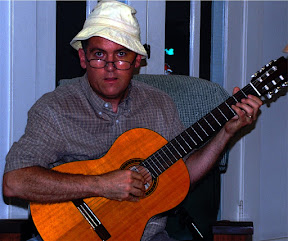
Some people have told me I look like the guy in the picture below... a certain "Gilligan," who endured a weekly "3-hour cruise" on television for three years in the 60s.
Each week, the weather started turning rough, and the tiny ship was tossed. If not for the courage of the fearless crew, the Minnow would have been lost. The ship set ground on the shore of an uncharted desert isle, with Gilligan, the Skipper too, the Millionaire and his wife, the Movie Star, the Professor and Mary Anne, here on Gilligan's Isle.

I can relate to him, since for me too the weather has had its rough moments lately. I am happy to report, however, that due to the diligent work of the Millionaire and his wife (government agencies such as NIH that fund research on brain cancer treatments, and private foundations that do the same), the Movie Star (those who raise public awareness of this potentially-devastating disease), the Professor (scientists and doctors involved in brain cancer research) and Mary Anne (family, friends, and others who provide the all-important emotional support), the castaways on the uncharted desert isle will be rescued, and returned to their lives before the ill-fated three-hour cruise.
Some people have told me I look like the guy in the picture below... a certain "Gilligan," who endured a weekly "3-hour cruise" on television for three years in the 60s.
Each week, the weather started turning rough, and the tiny ship was tossed. If not for the courage of the fearless crew, the Minnow would have been lost. The ship set ground on the shore of an uncharted desert isle, with Gilligan, the Skipper too, the Millionaire and his wife, the Movie Star, the Professor and Mary Anne, here on Gilligan's Isle.

I can relate to him, since for me too the weather has had its rough moments lately. I am happy to report, however, that due to the diligent work of the Millionaire and his wife (government agencies such as NIH that fund research on brain cancer treatments, and private foundations that do the same), the Movie Star (those who raise public awareness of this potentially-devastating disease), the Professor (scientists and doctors involved in brain cancer research) and Mary Anne (family, friends, and others who provide the all-important emotional support), the castaways on the uncharted desert isle will be rescued, and returned to their lives before the ill-fated three-hour cruise.
Tuesday, August 21, 2007
Types of Brain Damage
One thing that is always a concern with brain tumors, and with the various forms of treatment, is the possibility of irreversible brain damage.
Physicians speak of the possibility of "mental deficits" due to the tumor invading or impinging on areas of the brain that govern important functions (memory, emotions, speech, vision, etc.) In some cases, there may be temporary deficits after surgery that eventually go away, or there may be permanent ones.
I was very pleased that when I woke up from the surgery I was "still me." I had my mental facilities intact, still remembered everyone, and still thought the same tired old jokes were funny that I did before the surgery.
Before the surgery, I met with a neuro-psychologist, who administered a series of tests to assess my pre-operative mental function. These tests mostly focused on memory. For example, she asked me to name all of the animals I could think of. Of course, having just returned from an African Safari, where I had the seizure that set this whole thing in motion, I tended to come up with African animal names: "Wildebeast, water buffalo, baboon, monkey, vulture, lion, cheetah, hyena, ...". I don't know if I got extra points for "exotic" animals or not.
Then another test went like this: She told me the sad story of Suzie Thomson of South Boston, who was a cook in a school cafeteria, and had 10 hungry children of her own. One day Suzie was out on State Street, and was mugged and robbed of $56. She went to the police station, and the officers were so moved by her story that they took up a collection among themselves to reimburse her for her losses.
The test consisted of her telling me this story, then another unrelated story (which I must admit I don't fully recall, but seemed to involve a young male driver out west in Texas or somewhere, who ran off the road into a ditch, and damaged his car).
She asked me to repeat the driver story, which was easy, since she had just told it to me. But then by surprise she told me to now tell her the Suzie Thomson story. It's hard to get back into a Boston frame of mind after thinking about the wide open highway in Texas!
Anyway, I did pretty well in recalling the details of the Suzie Thomson story, and it seemed that most points were given for recalling details. I remembered her last name because it is the same as that of the famous physicist Lord Thomson, who proposed the "jellium" model of the atom in the early days of atomic theory. And I've been to Boston many times, so I know just where State Street is. (Although the concept of Boston police taking up a collection from their own funds led to some mental dissonance...)
I wonder if the story had been about, say, "Hedda Jmnanovich of Vransk, Poland" if I would have done as well. I've never been to Poland, and can't think of any clever tricks to remember those names... I don't know any streets in any city in Poland.
Anyway, she told me overall I scored above the 99th percentile. As a Caltech academic, this meant a lot to me. At Caltech, we like the 99th percentile. If you are much below than in your high school class, you won't get in as a student. And if you're not at that level as a graduate student, no search committee will recommend you for an Assistant Professor position. So that sounded good to me.
We didn't do a post-operative test, but I don't feel like I'm in any lower percentile now than before.
But it was eye-opening to me to see how they typically measure mental function. It is essentially what we engineers would call "unit operations:" elementary operations, not reducible to simpler steps. For example, they are interested in measuring how fast you can pull words out of memory: "List as many words as you can in 30 seconds starting with the letter S, not including proper nouns". But there was no test concerning pulling the right words out of memory!
For example, an interesting and practical test would be: "Name your wife", or "name your oldest son". If your wife is "Mary" and you say "Sue", I could imagine that this mental deficit might have some very long-lasting and severe consequences. These are the memory tests that matter in the real world! Other practical tests might be "When is your anniversary?", "What is your wife's birthday?". For the record, these are deeply ingrained into my brain, tumor or no tumor.
And then there is the question of mental deficits in reasoning. I was told that the left temporal lobe was responsible for, among other things, integrating individual memories, or sensory input, into more complex ideas. So what really concerned me was that either due to the tumor, or to the surgery to remove it, I might come to find nothing wrong with the following nonsensical statements:
The mental deficit characterized by belief that the erroneous statements 4 through 7 are true I will call "republicanism", a very widespread affliction of the brain in the areas that govern logic and common sense. This mental disorder only a few years ago afflicted approximately 51% of the American voting public. I am happy to report that today the disorder (especially as measured by question 6) only afflicts about 1/3 of the voting public. It seems that this great success was not due to advances in neuroscience, but to the ability of the brain to identify patent absurdities, and reassess the premises that led to absurd conclusions, such as "Dick Cheney is a smart man who values the opinions of all, and would make a great President."
It is this sort of mental deficit that would really impact my life and career. For example, it would be mildly interesting to ask a question like: "List as many hyperbolic partial differential equations (PDEs) as you can in 30 seconds." But far more relevant would be "list an appropriate set of boundary and initial conditions for a hyperbolic PDE in 2 dimensions; repeat for parabolic and elliptic PDEs." I have to say that if I confused hyperbolic and elliptic PDEs (one of which has wave-like solutions with finite propagation speeds, and the other of which propagates information infinitely fast -- I assume you know which one is which) then I would really be concerned about a mental deficit. Fortunately, the distinctions between hyperbolic, parabolic, and elliptic PDEs is as clear to me today as it was in graduate school, or as it was pre-surgery. I guess we can conclude that the tumor was far from the PDE center in my brain.
Or another thing that would have devastating personal consequences would be if the "thermodynamics" center were affected. For example, if I agreed with any of the following erroneous statements, it would be clear and devastating evidence of a career-ending brain disorder:
Fortunately, as far as I can tell, my "thermo center" is still functioning well. This means I will be able to keep working on my current research projects, including:
Also, a mental deficit in the "software center" would be devastating for me professionnally. This could be diagnosed by checking for agreement with any of the following erroneous statements:
As far as I can tell, my software center is still intact.
So in summary, it seems the essential parts of my brain for my life and work are still functioning as well as ever (but unfortunately no better than previously... ). So somehow this ~ 1 inch by 1.5 inch tumor was located in some part of my brain that doesn't seem to do much of anything. Perhaps it was located in the "team sports playing" center, or the "civic club joining" center, neither of which seem to work anyway.
Well, that's about all for now -- its nearly my bedtime. I suspect some of you may be thinking about now: "Don't you just hate it when someone thinks surviving brain cancer suddenly makes them qualified to be a stand-up comedian?" I suppose it is possible that I have a deficit in my "tasteful humor" center, or my "knows when to shut up" center. If so, probably years of therapy will be needed...
OK, good night all!
Dave
Physicians speak of the possibility of "mental deficits" due to the tumor invading or impinging on areas of the brain that govern important functions (memory, emotions, speech, vision, etc.) In some cases, there may be temporary deficits after surgery that eventually go away, or there may be permanent ones.
I was very pleased that when I woke up from the surgery I was "still me." I had my mental facilities intact, still remembered everyone, and still thought the same tired old jokes were funny that I did before the surgery.
Before the surgery, I met with a neuro-psychologist, who administered a series of tests to assess my pre-operative mental function. These tests mostly focused on memory. For example, she asked me to name all of the animals I could think of. Of course, having just returned from an African Safari, where I had the seizure that set this whole thing in motion, I tended to come up with African animal names: "Wildebeast, water buffalo, baboon, monkey, vulture, lion, cheetah, hyena, ...". I don't know if I got extra points for "exotic" animals or not.
Then another test went like this: She told me the sad story of Suzie Thomson of South Boston, who was a cook in a school cafeteria, and had 10 hungry children of her own. One day Suzie was out on State Street, and was mugged and robbed of $56. She went to the police station, and the officers were so moved by her story that they took up a collection among themselves to reimburse her for her losses.
The test consisted of her telling me this story, then another unrelated story (which I must admit I don't fully recall, but seemed to involve a young male driver out west in Texas or somewhere, who ran off the road into a ditch, and damaged his car).
She asked me to repeat the driver story, which was easy, since she had just told it to me. But then by surprise she told me to now tell her the Suzie Thomson story. It's hard to get back into a Boston frame of mind after thinking about the wide open highway in Texas!
Anyway, I did pretty well in recalling the details of the Suzie Thomson story, and it seemed that most points were given for recalling details. I remembered her last name because it is the same as that of the famous physicist Lord Thomson, who proposed the "jellium" model of the atom in the early days of atomic theory. And I've been to Boston many times, so I know just where State Street is. (Although the concept of Boston police taking up a collection from their own funds led to some mental dissonance...)
I wonder if the story had been about, say, "Hedda Jmnanovich of Vransk, Poland" if I would have done as well. I've never been to Poland, and can't think of any clever tricks to remember those names... I don't know any streets in any city in Poland.
Anyway, she told me overall I scored above the 99th percentile. As a Caltech academic, this meant a lot to me. At Caltech, we like the 99th percentile. If you are much below than in your high school class, you won't get in as a student. And if you're not at that level as a graduate student, no search committee will recommend you for an Assistant Professor position. So that sounded good to me.
We didn't do a post-operative test, but I don't feel like I'm in any lower percentile now than before.
But it was eye-opening to me to see how they typically measure mental function. It is essentially what we engineers would call "unit operations:" elementary operations, not reducible to simpler steps. For example, they are interested in measuring how fast you can pull words out of memory: "List as many words as you can in 30 seconds starting with the letter S, not including proper nouns". But there was no test concerning pulling the right words out of memory!
For example, an interesting and practical test would be: "Name your wife", or "name your oldest son". If your wife is "Mary" and you say "Sue", I could imagine that this mental deficit might have some very long-lasting and severe consequences. These are the memory tests that matter in the real world! Other practical tests might be "When is your anniversary?", "What is your wife's birthday?". For the record, these are deeply ingrained into my brain, tumor or no tumor.
And then there is the question of mental deficits in reasoning. I was told that the left temporal lobe was responsible for, among other things, integrating individual memories, or sensory input, into more complex ideas. So what really concerned me was that either due to the tumor, or to the surgery to remove it, I might come to find nothing wrong with the following nonsensical statements:
- One plus two equals five.
- The laws of thermodynamics may be revoked.
- A machine that takes in no work and transfers heat from a cold to a hot reservoir with no other effect on the environment is possible to build.
- The evidence presented by Colin Powell at the UN before the invasion of Iraq constituted proof that Saddam Hussein had or was building weapons of mass destruction.
- There was credible evidence of a link between Saddam Hussein and Al-Queda.
- George Bush is a good President.
- The profit motive is good for the US education and health care systems.
The mental deficit characterized by belief that the erroneous statements 4 through 7 are true I will call "republicanism", a very widespread affliction of the brain in the areas that govern logic and common sense. This mental disorder only a few years ago afflicted approximately 51% of the American voting public. I am happy to report that today the disorder (especially as measured by question 6) only afflicts about 1/3 of the voting public. It seems that this great success was not due to advances in neuroscience, but to the ability of the brain to identify patent absurdities, and reassess the premises that led to absurd conclusions, such as "Dick Cheney is a smart man who values the opinions of all, and would make a great President."
It is this sort of mental deficit that would really impact my life and career. For example, it would be mildly interesting to ask a question like: "List as many hyperbolic partial differential equations (PDEs) as you can in 30 seconds." But far more relevant would be "list an appropriate set of boundary and initial conditions for a hyperbolic PDE in 2 dimensions; repeat for parabolic and elliptic PDEs." I have to say that if I confused hyperbolic and elliptic PDEs (one of which has wave-like solutions with finite propagation speeds, and the other of which propagates information infinitely fast -- I assume you know which one is which) then I would really be concerned about a mental deficit. Fortunately, the distinctions between hyperbolic, parabolic, and elliptic PDEs is as clear to me today as it was in graduate school, or as it was pre-surgery. I guess we can conclude that the tumor was far from the PDE center in my brain.
Or another thing that would have devastating personal consequences would be if the "thermodynamics" center were affected. For example, if I agreed with any of the following erroneous statements, it would be clear and devastating evidence of a career-ending brain disorder:
- It is possible to fully convert heat into work.
- Entropy can be destroyed.
- Energy can be created.
- Global warming is not a problem, no need to change anything about our society to minimize emission of CO2.
- Perpetual motion machines are possible, and research into these "novel concepts" deserves DOE funding.
Fortunately, as far as I can tell, my "thermo center" is still functioning well. This means I will be able to keep working on my current research projects, including:
- A new collaboration with Sossina Haile in Materials Science, funded by Stanford's Global Climate and Energy Program, to develop high performance solid oxide fuel cell electrodes using recently-developed nanofabrication methods.
- The ONR "Research Tools" program, in which we are developing quantitative models and modeling tools for high-temperature solid-state electrochemical systems
- Cantera, my object-oriented C++ software package for simulations involving coupled chemistry, electrochemistry, transport processes, surface chemistry, etc.
- Our DARPA-funded work on plasmon-enhanced heating via nanoparticles as a tool for deposition of nanostructures, and for pumping, distilling, and concentrating liquid solutions for "lab on a chip" applications.
Also, a mental deficit in the "software center" would be devastating for me professionnally. This could be diagnosed by checking for agreement with any of the following erroneous statements:
- If a project presentation has colorful PowerPoint slides, the science must be good.
- MS-Windows is just as good an operating system as Mac OS-X.
- Fortran 77 is a fine programming language; I don't need to learn any C++.
As far as I can tell, my software center is still intact.
So in summary, it seems the essential parts of my brain for my life and work are still functioning as well as ever (but unfortunately no better than previously... ). So somehow this ~ 1 inch by 1.5 inch tumor was located in some part of my brain that doesn't seem to do much of anything. Perhaps it was located in the "team sports playing" center, or the "civic club joining" center, neither of which seem to work anyway.
Well, that's about all for now -- its nearly my bedtime. I suspect some of you may be thinking about now: "Don't you just hate it when someone thinks surviving brain cancer suddenly makes them qualified to be a stand-up comedian?" I suppose it is possible that I have a deficit in my "tasteful humor" center, or my "knows when to shut up" center. If so, probably years of therapy will be needed...
OK, good night all!
Dave
Subscribe to:
Posts (Atom)